Tuesday, 14 May 2013

The Art of the Japanese Cocktail

The moga style starts to appear alongside traditional dress

The 1920s saw a rush of modernization in Japan, bringing an interest in Western culture and fashion. Photos, movies and illustrations from the time show a casual coexistence of traditional costume and the new flapper look of the modan gaaru (“modern girl”), or moga for short.

Part of this Western culture was the cocktail, and there are some great posters, matchbooks and other ephemera from the time featuring iconic cocktail glasses worked into very Japanese design. According to modern bartending legend Kazuo Uyeda, the cocktail really took off after the Second World War, at which time “you could find a cocktail shaker in every home and a Martini glass in every hand”. But the Japanese art of bartending developed along its own lines, with the culture’s typical respect for procedure and interest in the subtle stimulation of all the senses. 

This kimono has the cover of a piece of
modern sheet music printed on it
When we decided to have a Japanese-themed event at the Candlelight Club I read Uyeda’s book Cocktail Techniques, originally published in 2000 and finally published in English in 2010 by Mud Puddle Books in New York. I was interested to see how much emphasis he places, in his own creations, on the visual side, often using liqueurs primarily, it seems, for the contribution of their colours. He includes a chart listing hues that can be achieved by combining other colours. For example, the Fantastic Léman, created for a cocktail competition held in Geneva, is named after the French word for Lake Geneva and uses blue curacao to achieve the colour of the lake. (Blue curaçao crops up quite a lot by modern mixological standards, for precisely this reason.) The cocktail M-30 Rain aims for a light greyish-blue shade that Uyeda sees as the colour of this rain.

Uyeda also invented a series of “Coral” cocktails, starting with the “City Coral” and continuing with others the names of which all begin with C. For these he devised a kind of salt rim where he dips the rim of a Champagne flute first into a liqueur—chosen for its colour—then into a deep tray of salt. This creates a line of colourful salt crust part way down the glass that does indeed resemble coral.

Tokio
In the end we served the Tokio cocktail, invented as the Japanese entry for an international competition, because its gentle pink colour is reminiscent of the April cherry blossom that prompted us to have the party in the first place. Vodka based, it uses rosé vermouth and pink grapefruit liqueur to achieve a subtle flavour that is fruity and floral with a bit of wormwood bitterness at the finish. We also served a cocktail he calls Καλος Κυμα (yes, in Greek characters), which he invented for actress Kyoko Enami, and which combines apricot liqueur with Midori, a bright green Japanese liqueur with a—frankly rather synthetic—melon flavour. Again using vodka as a base that is neutral both in flavour and colour, it has an amber-green hue.

Uyeda is probably most famous as the inventor of the “hard shake”. He feels that all cocktails using fruit juice need to be shaken hard to blend the juice properly and to get air bubbles into the mix. His hard shake combines rapid back-and-forth shaking with rolling and twisting motions—in nautical terms, roll, pitch and yaw, all at the same time. I think the idea is to get as much chilling as quickly as possible to reduce unnecessary dilution; he also prints a chart of his experiments with different sizes, shapes and numbers of pieces of ice, both with shaking and stirring, to see what produces the best chill with least dilution. (For the record he believes a combination of small and large pieces works best.) He also believes in “washing” the ice with a plain water pre-shake, to wear off the corners of the ice pieces, which would otherwise be the parts most prone to melting and diluting the drink.

Καλος Κυμα
Given all this, it is odd that, instead of pouring the finished drink through a fine strainer as some bartenders do, he inverts the shaker completely, holds it low in the glass and gives it a good rattle to make sure all the little shards of ice end up spread across the surface of the drink and are not caught in the shoulder of the shaker. In some videos of him making a Gimlet you will also see him open the shaker, remove a choice piece of ice with a bar spoon and place this in the cocktail. (I have read online that the point of this is to show how spherical the ice piece is, but in his book Uyeda explains that it is simply to keep the drink cool, as the Japanese tradition is to serve Gimlets in a Champagne coupe glass and there is a fear that the width of the glass would otherwise cause the drink to warm up too quickly.) 

Whereas most bartenders use tin-and-glass Boston shakers, Uyeda prefers the Manhattan style shaker with built-in strainer. In a bizarrely unforthcoming interview for Imbibe, when asked why he prefers this kind of shaker, he replies only that, “If you realize how important shaking and mixing are, you will naturally notice that only the three-piece shaker could work out.” Uyeda also doesn’t use speed-pourers, and offers advice in his book on the best way to remove the cap from a bottle.

Despite the visually unusual cocktails he has invented, Uyeda, when asked by Imbibe, says that the cocktails he considers himself most associated with are the Martini and the Gimlet. The latter is a classic combination of gin and Rose’s lime cordial, but Uyeda instead uses lime juice and sugar syrup. His reasoning is: why use preserved lime juice when you can use fresh? But you could argue that this misses the point of the cocktail, in which the distinctive taste of the cordial plays a role.

It’s refreshing to encounter someone like Uyeda who develops all his ideas from first principles, rather than just carrying on tradition and conventional wisdom. (He says he doesn’t go to other people’s bars; he also announces that no one but him can do the hard shake properly, though this must presumably be a logical assumption rather than the result of watching other people try.) I quickly gave up trying to master the hard shake, but I have found myself pouring cocktails in the same way to shake out the ice shards. I’ve always rather liked using Manhattan shakers anyway, and I personally feel that a bit of dilution can be a good thing in a cocktail.

Thursday, 28 March 2013

G'Vine seeks the flower of London's bartenders

The breathtaking view from Paramount at the top of Centrepoint

To Soho last Monday, for the finals of the London leg of the G’Vine “Connoisseur Programme” 2013, in the Paramount bar at the top of the Centrepoint Tower. Despite the grandiose title, this is a bartender competition of the kind that many brands have, now in its third year. Other cities are having their own local contests, and the winners will vie to be the British representative in a global final.

Floraison (left) and Nouaison (right)
Such competitions are very much part of the woodwork these days. Obviously they raise awareness of the brand among the bartending profession, but it’s also interesting how they are part of an understood pathway for bartenders themselves: you start in a bar, but where can you go from there, other than perhaps owning your own place? With these competitions you can be elevated to national or international renown. Then there is the concept of the Brand Ambassador, a hired representative—always from a bartending background, as opposed to the Brand Manager who is presumably from a marketing background—travelling around promoting the brand to other bartenders. In fact this year’s G’Vine competition is styled L’Edition Ambassadeur, acknowledging that it is a hunt for a brand ambassador. Gin expert Phil Duff, who help set up the competition, observed that since the first programme in 2010 the finalists were being snapped up as brand ambassadors by other brands within weeks of the competition closing.

Hannah receives her prize from soi disant cocktail
legend Salvatore Calabrese 
Once again I was part of a mob tasting the cocktails on offer and voting for our favourite. I find these events a fascinating snapshot of which cocktail ideas are trending and how mixologists respond to the base spirit they are working with—in short, what they think cocktails are all about. G’Vine itself is a French gin launched in 2006. Unusually the spirit is distilled from grapes, and they bring out this character by including vine flowers in the botanicals. It comes in two versions, Floraison (with the green cap), at 40% ABV, with a soft, sweet and floral character, and Nouaison (with its sterner, more masculine grey cap), which is stronger, at 43.9%, and has a more conventional, juniper-driven style, though still exhibiting the floral notes (both versions seem to have sweet, spicy elements of ginger too). This strategy of simultaneously launching two expressions, one aimed, frankly, at ladies and people who basically don’t like gin (c.f. Bloom, another floral gin aimed at the female market), and a stronger more ginny gin intended to capture that sector of the market that does actually like gin, seems to me to be exactly what Adnams did by bringing out their Distilled Gin and First Rate gin together.

Sebastien explains his cocktail. Contestants were
marked up for having all this gubbins at their stations
As ever, there were some pretty exotic combinations on offer on the night. Winner Hannah Lanfear from Boisdale in Canary Wharf offered up the Mary Jean, a Tiki-ish mixture with Coco Real cream of coconut, grapefruit juice and Aperol. The overall balance was a bit tart in my opinion, though the most interesting thing was the use of Abbott’s bitters, a strongly cinnamon-flavoured tincture that I had not encountered before. It was served with a freeze-dried rosebud as a garnish, though given the thick, opaque nature of the drink it looked to me like it was spiralling on the surface of a prehistoric tar pit before being sucked below, perhaps to emerge millennia later as amber…

Andreas with his absinthe fountain, a smoking
gun (hidden) and various sprays
Tea was once again widely in evidence. Runner-up Sebastien Kasyna from Coq d’Argent offered a mix of Lillet Blanc, umeshu plum wine, green tea and melon juice, which was refreshing but a bit tannic and dry overall. And Fredi Viaud from Charlotte’s Bistro, who could talk the hind legs off a donkey, directly infused an Earl Grey teabag in the gin, then added oloroso sherry and the wonderful Fee Brothers Plum Bitters. This had an amazingly complex aroma of sherry, plums and figs, though on the tongue it was very thin and astringent. Even as someone who likes a dry Martini, I found this too dry to drink very much of.

The other runner-up was Andreas Tsanos from Spirit Level @ Baku, about whose concoction I had mixed feelings. On the one hand it was profound and flavoursome, redolent of odd things that weren’t in it, like preserved lemons, smoked bacon, pungent honey and surgical spirit. On the other hand the process was almost comically complex, involving La Maison Fontaine absinthe smoked with oak, hickory and applewood, bergamot mist, Champagne reduction, rose petals, lavender and vanilla. There is a part of me that feels that a good cocktail is greater than the sum of its parts, rather than burdened down by them.

"I am French, I talk with my hands," explained
Fredi. He also talked a lot with his mouth
For all that, Andreas’s cocktail was actually one of my favourites, along with the May Fair’s Dimitris Gryparis’s blend of Antica Formula vermouth, rosemary-infused honey, grapefruit juice and orange juice, which made an intriguing balance between the grapefruit and the vanilla/chocolate character of this great vermouth. But a refreshing alternative came from Caroline Hoskins of House of Tippler in East Dulwich. Her cobbler-style drink consisted of Floraison gin, St Germain elderflower liqueur, grapefruit juice and sauvignon blanc wine. Wine-based cocktails are making a comeback but they are still pretty rare, and this one got my vote eventually for being both refreshingly different and having an uncluttered harmony, with all the elements making a clear contribution—including the gin itself.

This last point is significant, as I did feel that some of the cocktails would have tasted much the same with any other gin, or indeed without the gin at all. Imants Zusmanis of Kensington Place presented a drink involving muddled strawberry, pineapple and fresh red chilli, plus June grapeflower liqueur (from the same makers as the gin), Nouaison, limoncello, pineapple juice, lemon juice, cranberry juice and sugar syrup—yet it was really just about the clever synergy between strawberry and chilli (although in my notes I do say that the gin character is at least detectable).

Imants Zusmanis prepares his intriguing strawberry n' chilli combo
One other notable mention should go to William Pravda from Merlin’s Bar and his L’Escalier cocktail. I thought this meant a staircase but he translates it as an escalator, with the idea that it has a rising flavour. It’s a charmingly old school drink mixing Floraison with Martini Rosso, Benedictine and Angostura Orange Bitters, so a bit like a Negroni or Martinez, with the gin flavour distinct, and it does indeed have a pleasing bitter aromatic quality that seems to rise up on the finish. He served it with a sugar rim and some grapes floating in it, but it was too sweet for me. He admitted that he himself preferred it without all this but if you want to win a cocktail competition you apparently have to go in for all this fol-de-rol. (His orange peel garnish was even clipped to the side of the glass with a tiny clothes peg.) I glanced at a marking clipboard over the shoulder of a judge and saw that there was actually a column for how the contestant decorated their station, and other such hooey.

So what would I do with G’Vine? When I first experimented with it I found it a bit disturbing in many classic gin cocktails, because its emphasis on soft, sweet, floral notes doesn’t deliver the juniper steel you expect. But in cocktails that are more floral to start off with, such as the Aviation, it works perfectly well, and brings it’s own interest. It also works well in a French ‘75—whether there is any synergy going on between the grape spirit and the Champagne I don’t know; more likely between the vine flower character and the Champagne. And I discovered it makes a rather good Gimlet, partly because the relative softness of the gin balances with the tartness of the citrus but also because the gingeriness of the gin makes a natural harmony with the lime.

Sunday, 10 March 2013

G-Line Whisky: A Scotch with an unusual production method

A Guest Writer Article from the IAE South Coast Branch
Today, I’m looking at a whisky that came as something of a surprise on a multitude of levels. Firstly, it arrived without my knowledge as a surprise from Germany (whence it had been ordered by DBS). Secondly, I tried it not knowing what it was. In our household, given our fondness for blind tastings, that happens quite a lot, but today DBS avoided any details for a different reason: I’m tasting G.Whisky No.1 from G-Spirits.
glinefounders
G-Spirits, based in Germany, is run by former barkeepers Maximilian and Julian Goldbach, who have been exploring adding something more to spirits than mere… well, spirit. They noticed that often a drink is so much more than just flavour, and sought to see how they could add something more to the experience of drinking a spirit. 

G.Whisky No.1 is a 12-year-old Scotch whisky, finished in sherry casks, that’s been poured over the breasts of Alexa Varga, Hungary's Playmate of the Year 2012. They even have a making-of video to show you how it’s done (they use a special basin). The company also make a vodka and a rum, and say that the models are chosen to reflect the spirit that they work with.
afpbooze2f-5-webTasting notes

Colour: Quite light—pale gold or Champagne.
Nose: Very pleasant: distinctly sweet, but with a slight tartness, like a combination of sweet liquorice, dark toffee and apple cider vinegar. There’s a little bit of wood polish at the end, too, but that’s pretty faint.
Taste: A long but light and dry note of woodiness to start with a little vanilla and light sherry. This then quickly develops: there’s a burst of toffee sweetness, which then swiftly changes to a different type of sweetness on the finish: one which is less like processed sugar and more fruity; it reminded me more of dried peach or apricot. The finish is also very warming indeed, which isn’t surprising given that it’s cask strength. I thought it would go particularly well in a hipflask, but—now that I know what it is—that strikes me as a rather expensive hipflask to keep!
So does it make a difference?
In reality, given health and safety regulations (and the fact that it’s cask strength alcohol), the impact on the whisky’s content and flavour is likely to be minimal, if anything; it’s primary impact is the psychological response that it inspires (whether that be positive or negative!).

Upon reflection, I am amused at how, after my initial surprise, I did look at the whisky slightly differently; in particular it seemed softer (it’s pretty soft for 57.9% ABV anyway). So maybe there’s something more to G-Spirits than initially meets the eye…
Selection
In Conclusion
Despite obviously not being in its target market, I liked the whisky—the flavour is smooth, but flavourful, with a range of lovely fruit notes, and has a great warmth and strength to it. I don’t think there can be any doubt that there’s a gimmick here, but the fact remains that it tastes lovely.
—Mrs B.
G-Line Scotch is available from their website for €139 for 500ml

Thursday, 7 March 2013

One small dinger for mankind

A Small Dinger
I have a troubled relationship with grenadine.

It’s an age-old cocktail ingredient, a syrup or cordial traditionally made from pomegranate (it’s name coming from grenade, French for pomegranate), sometimes slightly alcoholic. But modern grenadine is berry-based, mostly blackcurrant. Syrup merchants Monin acknowledge this shift by producing both a “grenadine” and a “pomegranate syrup”. I don’t know why this change happened—perhaps because traditional grenadine is both sweet and tart, and modern palates maybe hanker after something less edgy.

In any case, I find all commercial grenadines have a bubblegum confectionary flavour that, even in small quantities, ruins most cocktails. (Monin’s pomegranate syrup is better, but still a bit synthetic.) So nowadays I make my own, very simply, by mixing equal parts POM Wonderful pomegranate juice (it comes in a dopey-looking segmented bottle but it is 100% pomegranate, apparently) with granulated sugar, heated in a pan until it all dissolves then allowed to cool. (Normal cocktail syrup I make with a ratio of two parts sugar by volume to one part water, but when I tried that with pomegranate juice I discovered that it set into a jelly at room temperature. Something like pectin in the juice? Who knows. But at 1:1 it stays liquid and, kept in the fridge, it seems to avoid going mouldy for a surprisingly long time.)

Anyway, I mention all this because I’d like to introduce you to a cocktail that, for my money, makes grenadine taste good. It’s called a Small Dinger* and I noticed it printed on the frontispiece of the 1935 reprint of Bar Florida Cocktails, in the 2008 facsimile edition produced by Ross Bolton. Its appeal lay in its simplicity and, at the same time, its oddness, mixing rum and gin, augmented only with the straightforward sweet-and-sour combo of grenadine and lemon juice.**

Small Dinger
1 shot gin
1 shot rum
½ shot grenadine
½ lemon juice
Shake with ice and strain into a cocktail glass.

But the really odd thing about the Small Dinger is that it really works. For me this is what cocktails are all about—you can pick out the contributions of all the ingredients, but the whole is somehow greater than the sum of its parts. On the nose you notice the fruitiness of the grenadine, then on the tongue you get a clear warmth from the rum, with the sugar spirit flavour coming through, plus the high juniper notes and dry spice complexity of the gin. And the sweet/tart of the grenadine fruit marries well: this is actually quite a high proportion of grenadine (many recipes call for just a dash) but it does not seem cloying as it both has a clear space for itself in the mix and is balanced by the sourness of the lemon juice. (You may need to juggle the exact proportions depending on the sweetness of the grenadine.)

The original recipe for the Small Dinger. Click to enlarge
I first tried this cocktail with Botran Reserva rum—I am, as you know, a fan of the whole Botran range. I’ve also tried it with Havana Club 7-year-old. But, as you can see, the original recipe specifies Bacardi rum (back in those days Bacardi was still made in Cuba, rather than Puerto Rico, Spain and other places, as it is now), a white rum, I assume; so I also tried it with Botran Reserva Blanca and Brugal Blanco. Frankly it works with all of them, though my personal preference would be the darker Botran Reserva, where the complex mid-range notes of dried fruit, vanilla an chocolate slot nicely in with the fresh fruit flavours and the high spice notes of the gin (I’ve been using Tanqueray as a typical, classic style for this experiment).

All I can really say is: try it. It needs no special ingredients (well, I would advise making your own grenadine, though it may work with commercial stuff) but represents that sort of mixological earth magic that we all have easy access to.

* You will find some suggestions online that the name is lewd, but so far as I can tell a dinger is just a contraction of 19th-century humdinger—a thing that is an excellent example of its kind.

** It’s not a common cocktail but some recipes you’ll find actually specify lime juice. It’s a bit of a controversy because some of these early Cuban books talk about limón verde, meaning lime, but which was sloppily translated just as “lemon”. Yet this recipe, as you can see, specifies simply jugo limon, so I assume we’re on fairly safe ground using lemon juice. It works nicely with lime too.

Tuesday, 5 March 2013

The looking-glass half full…

David with a row of Pop Goes the Walrus cocktails
As I have commented before, I don’t normally do bar reviews, but I was invited along a couple of weeks ago to the launch of a new watering hole managed by a chum, David Hamilton-Boyd. I actually know David more for food than drink, as he has in the past run the food operation at Candlelight Club events—a fact that seemed to become more significant as the evening went on.

The place is called the Looking Glass Cocktail Club and, as the name suggests, there is an Alice in Wonderland theme going on. The Hackney Road venue has a small front bar decorated in standard Hoxton style with patches of exposed brickwork and pendant clusters of those exposed-filament lightbulbs you see everywhere. At the back, to the right of the bar is a huge gilt-framed mirror—which one would probably assume was just that, were it not for the fact that, at least on the launch night, there was a girl opening and closing it. Yes, it is a door into the much larger back bar. Through the looking glass indeed.

Entertainment
The styling of the back bar was similar, with a sparse collection of low furniture in clumps around the sides. I gather that some artwork will be going up on the walls. I spoke to the owner, who, interestingly, wanted his bar to become a venue for leftfield performance art—and indeed we were treated to some surreal keening from a young lady in skeletal corsetry. Oddly, though, there is no stage and the owner has no intention to install one.

But what of the drinks? As David zipped energetically about behind the bar clad in a purple Mad Hatter-esque topper and tie, I sampled four of the libations on offer. Some of them have Lewis Carroll names like Check Mate, Pop Goes the Walrus and the Looking Glass Fizz, while three of them have tea-related names and are indeed served in teacups—here evoking the Mad Hatter’s tea party, rather than the more common Prohibition speakeasy connotations. First up was the Shades of Green, blending the highly characterful, single-distilled Vestal vodka with a homemade dill syrup and absinthe mist, served with a cornichon pickle. The vegetal notes dominate, aromatic dill blending with the absinthe botanicals and the tart sappiness of the pickle, plus some saltiness from somewhere. David won a Vestal competition with this one.

Next I try the Pop Goes the Walrus, a psychedelic tour de force based around “buttered popcorn bourbon”. I’d previously heard that David made this, and I had tried to imagine what popcorn really tastes of other than the things one tends to put on it, like butter, caramel, salt, etc. Here the flavoured bourbon is blended with caramel syrup and milk, and served with a few bits of popcorn floating in it. Straightaway you get a bitter, toasted waft on the nose that does indeed remind you of popcorn, along with a butteriness too. On the palate there is a strange green, savoury note. Overall the cocktail is a like a buttery Baileys but with a drying cereal element—it does remind you of what popcorn tastes like. (It’s also unsurprisingly rich, so I doubt you would assay more than one in an evening.)

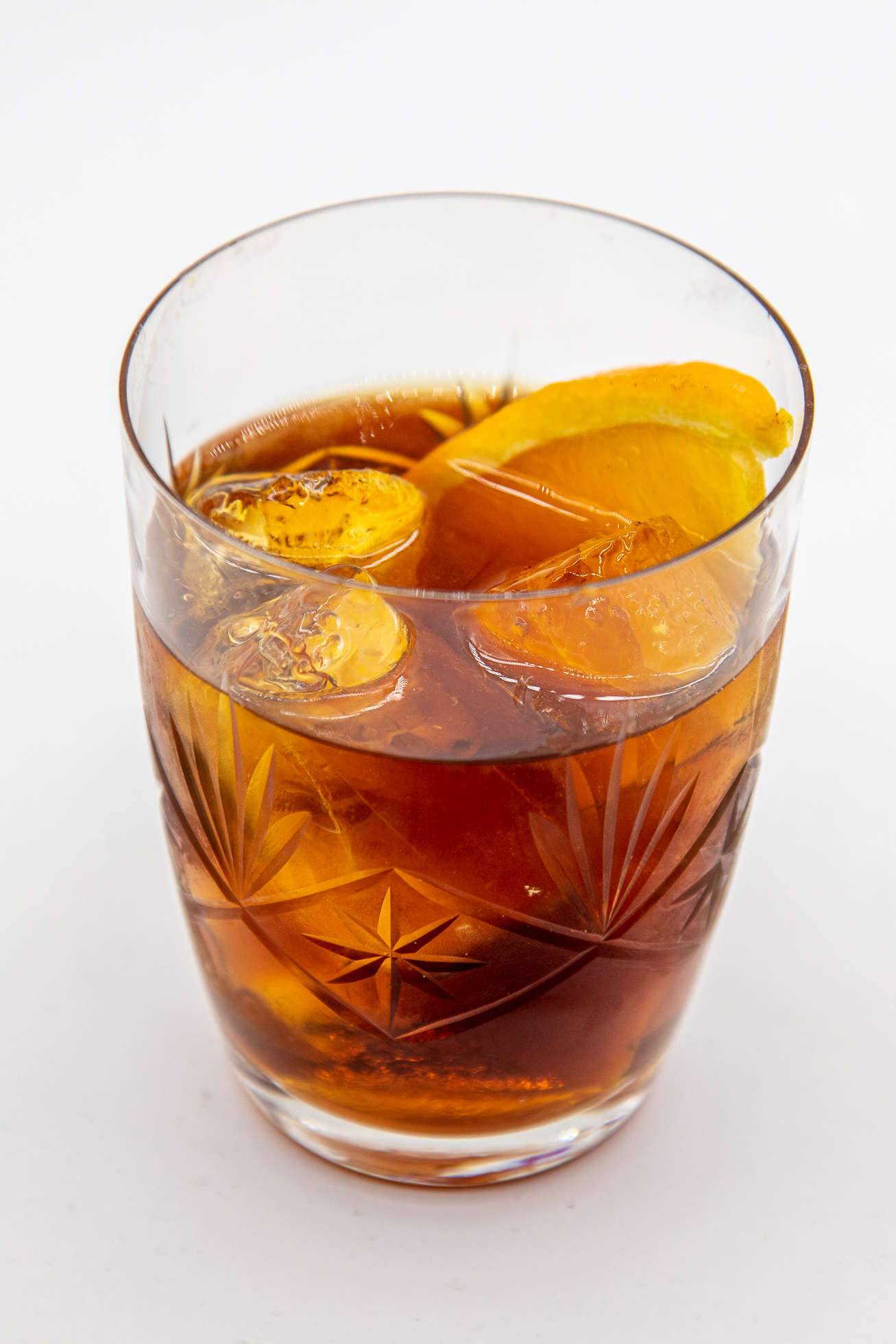
Then David hands me a Modern Gentleman. He is unable to explain why he gave it that name, but at £12 it’s the priciest drink on the menu—being based around El Dorado 21-year-old rum. It’s essentially a sort of rum Old Fashioned, sweetened with salted caramel and served with both an orange wedge and a spray of Mozart chocolate bitters over the top. This construction intrigued me, as the aroma of the bitters lingered for the whole life of the drink, blending with the sweet orange scent, always present on the nose but not really on the tongue. I guess the idea was to highlight the chocolate, orange and caramel notes in the rum, and I picked up elements of vanilla and banana too. And then there’s the salt again, here suggesting maritime brine, which seemed apt for a drink like rum, with its seafaring connotations.

Could this be the dill or tarragon syrup?

But this is what struck me most about the cocktails I tasted: their savouriness, whether it is the salt, the herby vegetable flavours or the dry cereal angle. I don’t have an especially sweet tooth, so I’m always being reminded to make sure the Candlelight Club cocktails are not too dry. But classic cocktail construction tends to revolve around a balance between the poles of spirit, sweet, sour, and maybe bitter herbal notes from vermouth, Campari, absinthe or aromatic bitters. The savoury elements in David’s cocktails reminded me more of food than anything. It could be a reflection of his other life as a chef, but to be honest it is a trend that has been going on for a while.

Perhaps the desire to break away from traditional cocktail flavours to explore new ones has been inspired by the way that deconstructionist “molecular gastronomy” has inspired “molecular mixology”, as evinced by places like Purl and its sister the Worship Street Whistling Shop, or the pop-up Burlington Social Club last year, where guests could enjoy cocktails made with “protein” served from eggshells. I applaud all such experimentation, though I find that in some cases it can be all mouth and no trousers—if you hadn’t read the elaborate description of what went into the drink and the exotic techniques involved, you would probably dismiss the result as something that just doesn’t taste of very much. And in some cases I also find the “theatre” just a bit too annoying, like the time I was served a cocktail that came entombed in a Bible and which somehow had to be consumed while inhaling from a vessel of frankincense smoke. Sometimes you just want a drink.

Mercifully David’s drinks don’t stray into that territory. But looking down the list I was struck by how foodie they seemed. The Looking Glass fizz consists of “stewed brambly apples” with blackberries and gingerbread and, almost as an afterthought, some Prosecco. The Check Mate contains star anise, vanilla and cinnamon tequila with pineapple juice and lemon curd (!). The High Tea goes even further and contains “oat-steeped vodka”, strawberry jam, milk and a rum & raisin cream.

A previously enjoyed Pop Goes the Walrus (in
the foreground), Modern Gentleman (left) and
Shades of Green (right)
My last cocktail at the Looking Glass Cocktail Club was the Storm in a Tea Cup, a mixture of bergamot liqueur, smoked vanilla vodka, lavender-infused Earl Grey tea and lemon juice. It had a satisfying balance of citrus, sweetness and tannin. (Tea may be fashionable in cocktails at the moment, but its used in mixed drinks goes right back to the first punches, which often contained it.) I found this actually the most moreish of the drinks I tried, and also liked the fact that it is served (in a teacup, naturally) with a sugar cube on the side in a spoon, a sugar cube impregnated with grapefruit bitters. The cube is not that eager to dissolve, so you can dunk it into your cocktail for as long as you wish, to achieve the sweetness that suits your palate. I liked this simple element of customization, but overall I just thought it combined intriguing complexity with a user-friendly approachability.

And if you just want a pleasant night out, it makes a more agreeable tipple than, say, wasp-infused tequila with a sump-oil foam and a methane mist, all served at one’s table in the cupped hands of a South American street urchin…

Monday, 11 February 2013

Botran Reserva Blanca

Francis from Distillnation came round the other day to drop off some absinthe and he presented me also with a handsome bottle of Botran’s new Blanca Reserva. It doesn’t officially launch in the UK till later this year, but when it does it will retail for about £22.

Botran are a Guatemalan family firm who have been making rum since 1939. Originally sugar cane planters, they still make all their rum with virgin cane juice from their own family estate in Retalhuleu, in the south of the country, using their own strain of yeast taken from pineapple, before ageing it slowly in the cool mountain town of Quetzaltenango. They use a mixture of bourbon (sometimes re-charred), sherry and port barrels and practise a “solera” system, more usually found in sherry production, where rums of different ages are constantly blended. To get an idea of just how elaborate this is, have a look at the flow chart below. Their current range consists of the Reserva, containing rums aged 5–14 years, and the Solera 1893, a drier, more profound blend of rums aged 5–18 years.

Click on the image to see a larger version
Their new white rum is not quite what it seems: for it too has been barrel aged using the solera technique; the current bottling contains rums aged 3–5 years and is made in the same way as the Reserva, except that there is no port barrel ageing. It is then charcoal filtered to remove the colour. Whereas most white rums are intended as mixers, Botran say theirs can be enjoyed both in cocktails and simply on the rocks.

Straightaway I can tell you that this Blanca makes a cracking Daiquiri,* with the rum coming through as tight and fruity, with a petrolly spirit thrust that pokes through the lime and sugar, yet bonds smoothly and perfectly with those flavours too. I try a Mary Pickford,** and again the rum lends an elegant power to this frothy, fruity number.

Neat, the Reserva Blanca has a juicy nose with elements of marzipan and cherry Bakewell. The palate is very soft and smooth for a white rum, and maintains the marzipan flavours. I have bottles of Bacardi and Havana Club 3-year-old to hand so I try them alongside: the Bacardi has a dry, sour nose by comparison, whereas the Botran is mellow and inviting with hints of chocolate. Likewise the Bacardi is thin and sharp on the palate, with a hint of blue cheese and seemingly a bit watery (though it is 37.5% ABV compared to the Botran’s 40%).

A Daiquiri made with Botran Reserva Blanca
The Havana Club has, unsurprisingly, a strong wood element on the nose and a tequila-like sourness. The palate likewise has a sawmill wood character plus a crude banana fruit. It somehow reminds me of the inside of a rubber balloon, and is quite tough to drink on its own. All of which goes to show how sophisticated the Botran is for a white rum, and how it is indeed a white rum you can enjoy neat.

OK, so the Botran Reserva Blanca will retail for almost double what you can find the Bacardi and Havana Club rums for in supermarket offers, but inevitably that careful ageing and filtering is going to come at a price. But how does the Blanca compare with the standard Botran Reserva? The Reserva has more obvious wood, plus dried fruit like figs, orange and raisins. I have a bottle of Havana Club 7-year-old knocking around so I do a comparison: this is dry, appley like Calvados and has a more stern, single-minded balance. By comparison the Botran Reserva is wreathed in sweet sugar and almond softness and smooth, smoky wood.

A Mary Pickford made with the Botran Blanca
Side by side, the Blanca has a much quieter nose than the Reserva, delicate, clean with a hint of a vodka-like medicinal note. The Reserva on the other hand immediately hits you with strong sherry notes, plus all that dried fruit. On the palate the Blanca channels more of the underlying sugar spirit character, a fuel for cocktails, but so much smoother than a typical white rum. The Reserva, by comparison, has a distinct oak wood character, which carries an acidity on the tongue that makes it in some ways less smooth than the Blanca.

This comparison helps me understand where the Blanca fits into the range. Whereas the Reserva (and more so the Solera 1893) is about in-your-face character and complexity, the Blanca is more about smoothness. I can see why they might encourage consumers to drink it neat, perhaps not as a profound character study, but as a clean, classy shot like premium vodka.

With this thought in mind I tried the Blanca from the freezer. It works OK, coming across at first with vodka-like medicinal notes, before the fruitiness hits and the sugar. I wouldn’t especially recommend it (but then I’ve never met a decent vodka that I thought was improved by being served frozen), yet it works well enough. For me the Botran Reserva Blanca works best in simple, classic rum cocktails.

* 2½ shots rum, ¾ shot lime juice, ¾ shot sugar syrup

** 2 shots rum, 2 shots pineapple juice, 1 tsp grenadine, dash of maraschino


Monday, 14 January 2013

Bootlegger white grain spirit

The utilitarian bottle and deliberately ragged label

It was at the London Boutique Bar Show last year that I first encountered Bootlegger. All their branding screams “Prohibition”—the utilitarian bottles and rough labels, the logo depicting a home still, and the “packing crate” style wooden presentation boxes. What with my involvement with the Candlelight Club I was inevitably curious.

Bootlegger is a spirit designed to evoke the unaged “moonshine” whiskey produced illicitly during Prohibition. There has actually been something of a trend towards bottling such “white dog” whiskies. Georgia Moon (actually made in Kentucky by Heaven Hill) comes in a large jam jar and proudly boasts it is no more than 30 days old. Buffalo Trace, Heaven Hill and Maker’s Mark have all bottled white versions of the spirits that usually go on to make their aged products, and in October Jack Daniel’s announced the launch of an unaged rye-heavy “white” whiskey. While there are many artisanal, crafted white dogs being made in the US, apparently very creditably, there is nevertheless a reason why most whiskey is aged in wood, at great expense, for a number of years. I’ve not actually tasted Georgia Moon—because the smell of the eye-watering fumes coming off it when the jam jar lid was unscrewed put me off. And the unaged bottlings of mainstream whiskeys are often presented more as experimental, “educational” products, to illustrate the journey that the “proper” products make towards their final matured form.

Note the rather pleasing indentations in the sides of the
bottle, giving your shaking fingers a good grip
So I didn’t have very high hopes when I tasted Bootlegger at the bar show—and I was pleasantly surprised. There is a whiff of vanilla and caramel on the nose (which reminds me a bit of Bailey’s) plus a warmth of dry grain spirit underneath. There is plenty of pepper on the palate but it is actually pretty smooth, again with vanilla, caramel and a chocolate finish, maybe with a hint of dry oatmeal. They are so confident of the palatability of their product that the preferred serve is actually sipped neat.

Given all the Prohibition associations, I was surprised to discover that Bootlegger is actually made in the UK for Halewood International. And it’s made entirely from wheat, not an obvious American whiskey grain. (There are wheated blends—Buffalo Trace have bottled a wheated white dog which normally goes on to make Pappy Van Winkle and W.L. Weller—but even here the wheat is part of a mix of grains.) “I did quite a bit of research,” says Halewood's Peter Eaton, whose brainchild Bootlegger was, “and they made moonshine out of pretty much anything that was to hand. We tried loads of different grains—and to be honest some of them, when I tasted the finished spirit, nearly burned my tongue off—but what we landed up with was a precise combination of English and French winter wheats, which produced the smoothest liquid.”

Bootlegger is entirely unaged, but has an “oak tincture” added, which gives that woody vanilla element, along with a slight yellow colour, to mimic the effect of the barrels that would have been used to transport moonshine—what Peter calls the “transportation flavour”. (House Spirit White Dog, another brand, is barrel aged for precisely three hours to achieve the same effect.) So in practice Bootlegger is arguably more like a moonshine-flavoured vodka. The wheat spirit undergoes a “multiple distillation process which results in a liquid of exceptional purity”—very much the way premium vodkas sell themselves. So you end up with something with the illicit associations of moonshine, and an appealing vanilla woody whiskeyness, yet with none of the searing roughness that can so easily characterise unaged whiskey, the mellowness coming in this case from the wheat grain and the multiple distillation rather than barrel ageing.

The label is all about Prohibition
Despite the emphasis on serving Bootlegger neat (their slogan is “Made for sippin’ while the moon shines”) it also makes a useful cocktail base, being relatively neutral with that light vanilla character. We based our Christmas Candlelight Club event around Bootlegger and served their signature cocktail, the Al Capone:

Al Capone
1½ shots Bootlegger
½ shot Grand Marnier
½ shot sugar syrup
½ shot lemon juice
2 dashes of bitters
Champagne to top
Raspberry to garnish
     Shake Bootlegger, Grand Marnier, bitters, lemon juice and sugar syrup in a cocktail shaker with ice and strain into a cocktail glass or coupette. Top with Champagne and garnish with a raspberry.

An Al Capone cocktail
Not dissimilar to Dale de Groff’s Ritz cocktail, this is a dangerously agreeable tipple, with orange and lemon backed by spirit warmth and the Champagne drying it slightly and adding a sparkling shimmer. It’s hard to imagine Al Capone drinking one, but if you ask the Internet what Al’s favourite tipple was, the only answer that comes back is Templeton Rye, made in the Iowa town of Templeton; evidently the townsfolk managed to keep producing throughout Prohibition, helped by Capone’s fondness for the stuff. And on the Templeton Rye website today is a cocktail called the Capone, essentially the same as this one but without the lemon and sugar. It’s not a Prohibition era drink, though—there is a YouTube video in which brand manager Michael Killmer says that he invented it himself.

Because it was a Christmas Ball, we threw in a cocktail of our own, invented for the Candlelight Club by Will Sprunt. Originally using gin as its base, it also works very well with Bootlegger, the vanilla element partnering well with cherry. The rosemary sounds unlikely, but what is fascinating about this drink is how well cherry and rosemary go together.

Cherry Christmas
2 shots Bootlegger
¾ shot cherry brandy
½ shot sugar syrup
¼ shot rosemary tincture
Dash of cherry bitters
Top with cranberry juice
     Shake everything but the cranberry with ice and strain into an ice-filled highball. Top with the juice and stir briefly. The rosemary tincture is created by adding fresh rosemary to vodka (maybe four sprigs per bottle, bruised a bit if possible) and leaving it to soak for about 24 hours.

If you’re curious to try Bootlegger, we’ll also be serving it to sip or a cocktail at our next Candlelight Club party, on 25th and 26th January…